



Dr. Damian Valles Molina
Assistant Professor, Ingram School of Engineering
Research Areas:
High-performance computing, machine/deep/reinforced learning, embedded edge systems, virtual and augmented reality, and robotics.
Background
Dr. Valles' areas of research include robotics, high-performance computing, machine learning, and embedded system implementations. He is the Director of HiPE Research Group, and a member of the Institute of Electrical and Electronics Engineers (IEEE), the Association for Computing Machinery (ACM), ACM’s Special Interest Group HPC (SIGHPC), and the Society of Hispanic Professional Engineers (SHPE).
Dr. Valles is a professor at Texas State’s Ingram School of Engineering. He graduated with a BS, MS, and PhD in Electrical and Computer Engineering from The University of Texas at El Paso.
About Faculty Fellows Projects
Dr. Damian Valles will develop and deploy an advanced AI system of autonomous units (rovers and drones) designed to help first responders navigate fires in multi-story buildings by detecting heat signatures, human screams, and toxic gases. His research aims to increase rescue efficiency, ensure firefighter safety, and allow for better decision-making during emergency responses. This project contributes to the health and resilience of both first responders and the public because healthy first responders are critical to maintaining a healthy community. More about this project can be found on his research site.
Research Impact Highlights
AI-Powered Tools for Faster, Safer Fire Response
AI Drones & Rovers
AI-enabled units collect real-time data in dangerous fire environments.
Detects Hidden Hazards
Detects heat signatures, human screams, and toxic gases inside buildings.
Safer Rescue Operations
Supports faster rescues and better decision-making during emergencies.
Featured Media
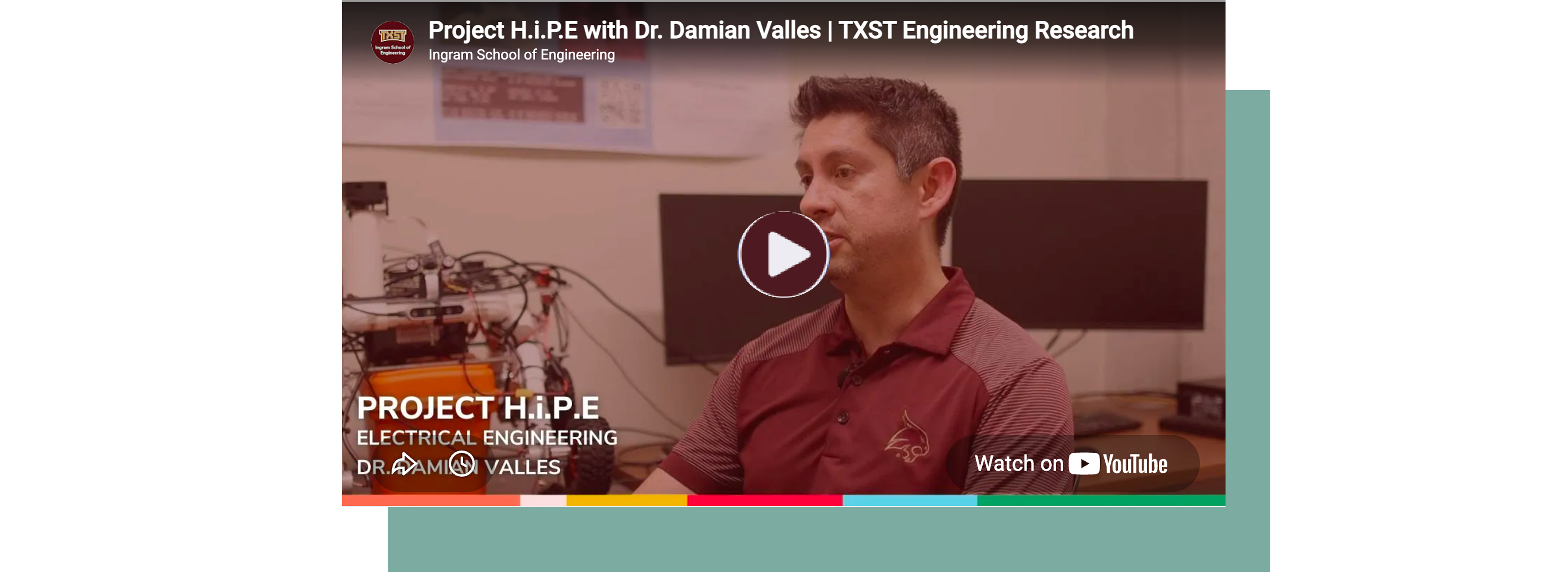
Project H.i.P.E with Dr. Damian Valles | TXST Engineering Research. Dr. Damian Valles is the head of the group HiPE. Their mission is to develop and innovate engineering solutions that utilize high-performance computing, machine learning, embedded edge systems, robotics, and virtual/augmented reality to address relevant computational research components in STEM, health care, and other fields.